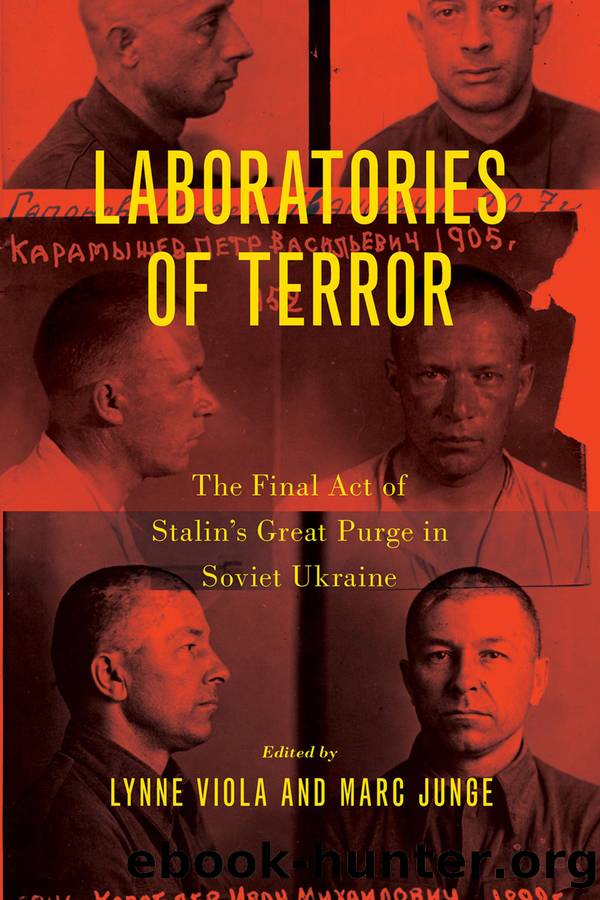
Laboratories of Terror by Lynne Viola
Author:Lynne Viola
Language: eng
Format: epub, pdf
Publisher: Oxford University Press
Published: 2022-06-15T00:00:00+00:00
4
___________
âEnemies Withinâ
Pertsov and the NKVD in Kharkov and Odessa
Vadym Zolotarâov
Translated by Simon Belokowsky
NKVD investigators David Pertsov, Ivan Kriukov, Iakov Sereda, and Aleksei Kopaev were imprisoned for âviolations of socialist legalityâ against their own (former) NKVD colleagues. The âannihilation of honest Chekist cadresâ was of course attributed to many investigators of the NKVD, but as a rule this charge was accompanied by other accusationsâconspiracy, espionage, sabotage. The logic of the accusations made against Pertsov and his colleagues suggested that they acted strictly within the bounds of âsocialist legalityâ with respect to ordinary Soviet citizens and were only particularly zealous in interrogating their own colleagues. Was this the case in reality? Were the indictments and convictions justified?
David Aronovich Pertsov was born into the family of a Jewish shoemaker in the town of Aleksandriia (an uezd or county seat of the former Kherson Gubernia) on 30 May 1909.1 He had two brothers, Savelii and Ruvim (Robert), who, in the mid-1930s, served in the Dnepropetrovsk Oblast UNKVD, as well as a sister, Olâga, married to the NKVD agent Isaak Shapiro.2 Pertsov began his working career on 15 February 1925 in the city of Ekaterinoslav at the Ukrainian Meatpacking and Slaughterhouse where he spent four years, moving up from the positions of butcherâs apprentice and butcherâs assistant to butcher. Not only did the difficult work of slaughter and meat-carving temper the young Pertsov physically, it also engrained within him a certain cruelty and habituated him to a bloody environment. Alongside his work, Pertsov simultaneously studied at a trade school where he received a general education completed in 1928. In March 1929, he found a job at the Dnepropetrovsk Okrug Audit Commission (revizionnaia komissiia) where, over the course of nine months, he worked as an inspector, senior inspector, and deputy commercial agent.3 The Audit Commission worked in close coordination with the security police staff. The Chekists there took a liking to the jaunty young man and offered him a job.
From 15 December 1929, Pertsov began his service as an auxiliary plenipotentiary of the Information Department of the Dnepropetrovsk Okrug GPU, where he gained his first experience in intelligence-gathering.4 On 15 September 1930, he was appointed assistant plenipotentiary of the Secret Department of the Zaporozhe City GPU, before being transferred on 20 November to the role of plenipotentiary in the Zaporozhe GPU Special Department, where he immediately joined the investigation of the âSpringâ case.5 In 1931, he became assistant plenipotentiary of the Zaporozhe GPU Secret Political Department and was a participant in the falsification of a case against a local cell of the so-called Laboring Peasantsâ Party, in connection with which twelve people were convicted.6 During the course of that investigation, the Chekists liberally applied measures of psychological and physical coercion: beatings, forced standing for long periods, the dangling of a high-powered electric lamp in front of victimsâ eyes for days on end, and nonstop, days-long interrogations.7
On 1 March 1932, Pertsov was appointed operative plenipotentiary of the Special Department of the 23rd Zaporozhe Aviation Brigade; on August
Download
This site does not store any files on its server. We only index and link to content provided by other sites. Please contact the content providers to delete copyright contents if any and email us, we'll remove relevant links or contents immediately.
| Arms Control | Diplomacy |
| Security | Trades & Tariffs |
| Treaties | African |
| Asian | Australian & Oceanian |
| Canadian | Caribbean & Latin American |
| European | Middle Eastern |
| Russian & Former Soviet Union |
The Secret History by Donna Tartt(19088)
The Social Justice Warrior Handbook by Lisa De Pasquale(12190)
Thirteen Reasons Why by Jay Asher(8910)
This Is How You Lose Her by Junot Diaz(6887)
Weapons of Math Destruction by Cathy O'Neil(6280)
Zero to One by Peter Thiel(5802)
Beartown by Fredrik Backman(5754)
The Myth of the Strong Leader by Archie Brown(5507)
The Fire Next Time by James Baldwin(5446)
How Democracies Die by Steven Levitsky & Daniel Ziblatt(5219)
Promise Me, Dad by Joe Biden(5153)
Stone's Rules by Roger Stone(5088)
A Higher Loyalty: Truth, Lies, and Leadership by James Comey(4964)
100 Deadly Skills by Clint Emerson(4925)
Rise and Kill First by Ronen Bergman(4789)
Secrecy World by Jake Bernstein(4753)
The David Icke Guide to the Global Conspiracy (and how to end it) by David Icke(4720)
The Farm by Tom Rob Smith(4512)
The Doomsday Machine by Daniel Ellsberg(4490)
